Learn more about PMS pixies and how to live with them!
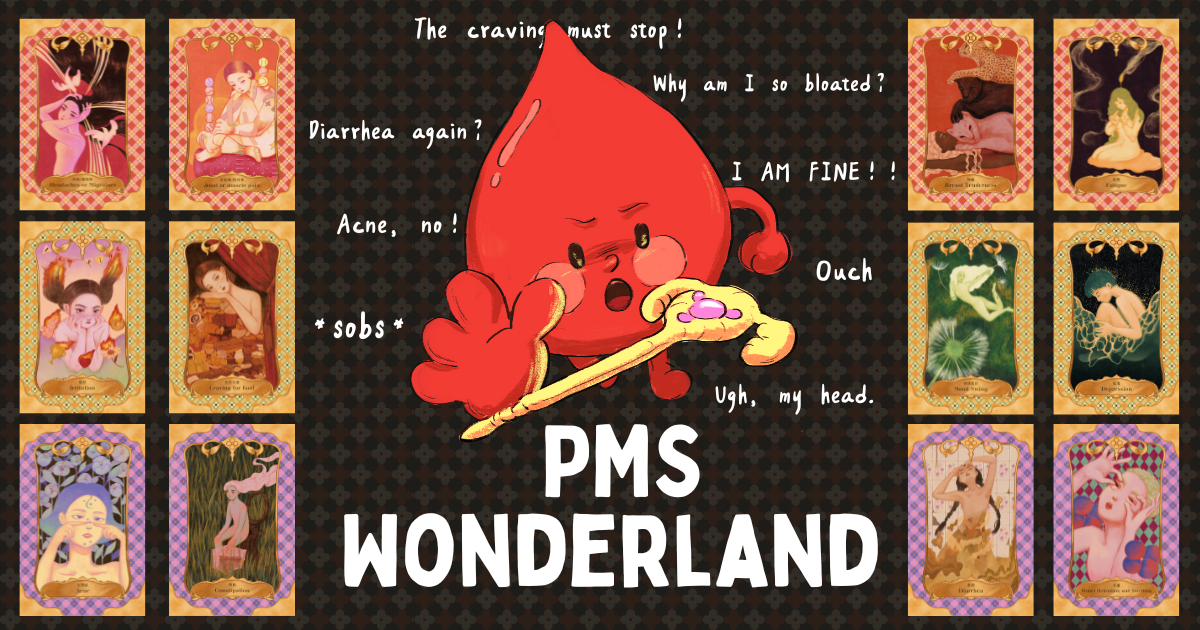
Enter "PMS Wonderland" and help Droppy seal away the PMS pixies!
🩸🧚♀️ Created by NGO With Red in collaboration with illustrator Ying-Ching, this interactive experience invites you to explore the many faces of premenstrual syndrome (PMS) through playful, engaging storytelling. Let’s decode the symptoms and the stigma, together!

Water Retention and Swelling
Staring at my reflection in the mirror like—how did I wake up looking like a pufferfish?? And are you kidding me, today’s the day we’re taking graduation photos! There’s no way that I can fix this with contouring. And it’s not just my face—my belly, arms, and legs are all ridiculously bloated. Everything I wear makes me look so bulky. Why does my period have to make it so difficult for me all the time?
Pain level: ★
Annoyance level: ★★★★
“I’m not chubby, I’m just water-rich.”
Right before menstruation, your body goes into full-on emergency prep mode for pregnancy and stockpiles everything: calories and water. That’s how you end up turning into a walking water balloon. Usually, once your period starts, the water weight and bloating disappear. But if they don’t... well, that probably means the period craving was a little too real!
⭕ | ❌ |
Drink more water (yes, for real) Potassium-rich food fights bloating—like spinach, sweet potatoes, bananas, and tomatoes. | Don't eat still for too long, get some movements! Avoid eating overly salty foods, and processed foods or refined carbs |
Before menstruation, hormone levels—especially progesterone and estrogen—rise, which can induce arginine vasopressin release and thirst onset. These changes cause your body to hold on to water, leading to bloating. Face, belly, and limbs are the most common areas to swell up.
It’s totally normal for your weight to go up slightly during this phase, and things usually ease up once your period begins. But if the bloating is seriously affecting your daily life, or if it sticks around even after your period ends, it’s a good idea to check in with a doctor.

Acne
Ughhh! I’ve been so on point with my skincare, so why did pimples suddenly break out like this? They have taken over my chin, nose, and forehead too?? And it’s the worst kind—the huge, gross, pus-filled kind!!
I know popping them can lead to infection and scarring, but I just can’t help myself. I’ll pop them, slap on a pimple patch, and cover it all up with foundation. Problem solved… right?
Pain level: ★★
Annoyance level: ★★★★
“Code Red: Zitpocalypse on Face Island!”
Right before menstruation, your hormones go completely off the rails—like a roller coaster with no brakes! Your poor, sensitive sebaceous glands can’t keep up, and bam! Your face turns into the set of a zombie apocalypse movie, pimples breaking out one by one. Forehead, nose, chin—total disaster zones.
⭕ | ❌ |
See a doctor and stick to medical treatments Wash your face with just water Go makeup-free | Don’t pop your pimples Bye-bye bedtime delays (no excuses!) No greasy, spicy foods and dairy |
Our skin is super sensitive to sex hormones like estrogen, progesterone, and androgens. Before menstruation, these hormone levels fluctuate wildly, which ramps up oil production in the sebaceous glands. On top of that, your body produces a bit of androgen (a male hormone), which triggers even more oil production—leading to an outbreak of pimples.
The chin and mouth area are especially acne-prone thanks to androgen sensitivity. Why? These are the same areas where men grow facial hair—meaning the sebaceous glands here are naturally more responsive to androgens. That’s why pimples feel so at home here, like they own the place!

Diarrhea
I seriously hate having my period. These past few days, I’ve had zero control over my cravings—I'm eating everything in sight. And on top of that? Constant diarrhea. Going to the bathroom is a whole production too. I have to hold onto my tampon string every time I poop, because if it swings back and touches anything... it’s game over. What? Tampons are expensive—I’m trying to make it last until it’s time to change!
Pain level: ★★★
Annoyance level: ★★★
“Tonight’s special: pain, blood, and bowel movements.”
When your period starts, your body releases prostaglandins to help your uterus contract and shed its lining—but your intestines also get invited to the party. Which means that your digestive system basically goes full clearance sale mode, flushing everything out like there’s no tomorrow. You’re left wondering if that stomach pain is cramps or just another trip-to-be to the restroom.
⭕ | ❌ |
Lighter, smaller, more frequent meals Stay hydrated and replenish electrolytes Foods that are rich in soluble fiber | Limit caffeine and alcohol intake Say no to spicy foods and dairy |
Right before menstruation, prostaglandins level rises, which can cause uterine contraction, helping the uterine lining shed—but they also kick your intestines into overdrive. That speeds up digestion and can lead to diarrhea. In some cases, prostaglandins may also affect your stomach, causing nausea or that queasy feeling.
If you always get diarrhea during menstruation—especially if it comes along with intense cramps or severe abdominal pain—it’s worth seeing a doctor. You might have endometriosis, a condition where uterine-like tissue grows outside the uterus (like on the ovaries, bladder, or peritoneum). If it grows near the bottom of the peritoneum—right by the rectum—it can irritate the intestines and cause diarrhea too.

Constipation
Is this... the third day already? I especially bought sweet potatoes and yogurt yesterday just for this, but still—no movement. I don’t know if it’s because of constipation or bloating, but my stomach feels so full and heavy. And today it looks ridiculously huge, I almost couldn’t zip up my skirt. I’ll just stop by the supermarket after work and cook something myself. Enoki mushrooms are a must. Pumpkin sounds good. A few bananas too… yup, this time I’mma ace it!
Pain level: ★★
Annoyance level: ★★★
“Sat forever, birthed nothing but a sigh.”
This is a silent tug-of-war, and my opponent… is me.
Thanks to progesterone, my intestines have been chilling and moving in slow motion for days. Every minute on the toilet feels like an eternity. I’ve already broken my personal record for longest bathroom stay—and even as a professional time thief(?) at work, I’m starting to feel a little guilty.
⭕ | ❌ |
Hydration is the key Believe in the power of fiber-rich foods | Don’t stay glued to your chair Don’t ignore the urge to “go” |
Before menstruation, rising levels of progesterone can slow down bowel movements, leading to constipation. Progesterone’s original mission is to relax the uterine muscles to prepare for a potential pregnancy—but it doesn't stop there. It also relaxes the smooth muscles of your intestines!
This slows down digestion, which means poop hangs out longer in the colon, gets overly dehydrated, and turns dry and hard—making it way harder to pass.

Fatigue
I’ve just felt so tired in the past few days.
At work, I’m stuck in a sleepy fog, can’t focus, can’t think. And when I finally make it home, I’m not blessed to sleep well. The weather’s cool, but I keep waking up in the middle of the night feeling way too warm, had to crawl out of bed to cool down the room just to fall back asleep.
Woke up dizzy, with a stabbing pain in my belly… and my head. Yup. My period’s here. I feel like I’ve been completely drained. If I really can’t handle it, I’m going to take menstrual leave... Only by resting well will I have the energy to work more efficiently!
Pain level: ★
Annoyance level: ★★★★★
“Too tired to even yawn.”
The alarm clock is the true villain of this story. I barely closed my eyes—why is it time to say goodbye to my beloved bed already??
You can blame hormones for this betrayal. Feel like you could fall asleep anytime, anywhere before your period? That’s progesterone. Can’t muster the energy to do anything at all? You’re running low on serotonin.
⭕ | ❌ |
Cool and comfy sleep space Light movement before bed: meditation, belly breathing, muscle relaxation | Don’t be on your phone till 2AM Don’t overdo coffee or sweets |
There are a few reasons why fatigue hits so hard before menstruation. To start with, progesterone levels rise before menstruation—and it has a calming, drowsy effect that makes you feel like someone has casted a spell on you. At the same time, serotonin levels drop, which affects your mood and energy levels, no matter how much sleep you get, you’re still tired.
Poor sleep quality might be due to other PMS symptoms like headaches, cramps, or breast tenderness. Plus, body temperature naturally rises by 0.3 to 0.5°C after ovulation, making you feel hotter and more restless at night.
To top it off, your GABA levels might drop. GABA is a neurotransmitter that helps calm the brain and promote deep sleep. When GABA is low, you might find it hard to fall asleep or be deep asleep, making fatigue a regular visitor before or during menstruation.

Joint or muscle pain
Pretty sure my period’s about to start—my lower back is killing me, and my legs ache like I’ve just run a marathon. I really don’t want to go to school today, but it’s midterms, so I have no choice.
I squeezed onto a packed bus during rush hour, and as expected, there were no seats. I felt awful but didn’t dare ask anyone to give theirs up. By the time I finally made it to school, I was already exhausted. Unfortunately, our classroom is on the 4th floor. Every step up the stairs, I could practically hear my knees screaming for mercy.
Pain level: ★★★★
Annoyance level: ★★★
“Every move comes with a protest notice.”
Woke up feeling sore all over, even walking made your knees feel creaky, like they haven’t been oiled in years? Congratulations for the deluxe PMS symptom pack: prostaglandins for that achy muscle feeling, a sprinkle of estrogen so your joints can throb too, and let’s top it all off with a nice round of water retention. Ta-da, mobility of a thousand-year-old mummy.
⭕ | ❌ |
Warm compresses for painful areas Eat magnesium-rich foods: bananas, leafy greens, nuts, or fish | Stop skipping your bedtime Don’t endure the pain |
Right before menstruation, prostaglandin levels rise to help trigger uterine contractions and shed the lining. But when prostaglandins enter the bloodstream, they can cause aches and soreness in other areas too—especially the lower back and pelvis. At the same time, estrogen levels drop. Since estrogen helps reduce inflammation, lower levels of estrogen can lead to more joint pain, swelling, and stiffness.
Hormonal changes can also trigger water retention. As progesterone levels fluctuate, the body tends to hold on to more water. This fluid buildup can make tissues around your joints swell, increasing pressure and causing discomfort or pain.

Headaches or Migraines
My head’s been pounding all morning. Both temples are throbbing nonstop, like tiny birds are pecking at my brain. A kind colleague gave me some painkillers—took one, felt slightly better, but there’s still this little hammer in my head, gently pounding away with a dull ache. I just want to go home and rest, but I’ve got an important meeting this afternoon. I have no choice but to pull myself together and push through.
Pain level: ★★★★★
Annoyance level: ★★★
“Shadows dance where clarity used to live.”
Right before your period, the hormones that normally suppress pain and help regulate your nervous system take a dramatic nosedive. It's like your body's pain defense system just shuts down. What happens next? Pain waltzes right in, takes over your brain, and hosts a chaotic ball in your skull.
⭕ | ❌ |
Get enough sleep See a doctor and take medicines as prescribed | Limit caffeine and alcohol intake Do not let stress pile up |
Studies show that PMS-related headaches and migraines are closely tied to the decrease levels in estrogen before menstruation. Estrogen helps regulate pain-related neural pathways, so when it drops, your body becomes more sensitive to pain. At the same time, serotonin levels—which also help reduce pain—drop too, raising the chances of headaches and migraines.
During the late luteal phase, the falling progesterone and estrogen reduces the activity of your body's natural painkillers: the endogenous opioid system. This makes you more sensitive to pain and more prone to mood swings and migraines. And no, taking painkillers in moderation isn’t harmful—your body can metabolize the medication. So if you’re in pain, don’t be afraid to take what you need.

Breast Tenderness
I was riding my scooter to work like I always do, but for the first time, I could really feel just how bumpy roads are in Taiwan today. Every little jolt made me want to cry.
Later that night, I was lying on the couch scrolling through my phone when my cat decided to go full parkour and launched off my chest like it was a springboard. The living room immediately turned into a crime scene, the police might soon show up and put up that yellow tape.
Pain level: ★★★★
Annoyance level: ★★★
“Handle with care: fragile and full of rage.”
Help! It feels like there are three big cats sitting on my chest!
That’s the hormonal duo of progesterone and estrogen teaming up, leading to breast swelling. Sometimes it even hurts—like having rocks stuffed in your chest. Breathing becomes a delicate art, and bras might as well become torture devices.
⭕ | ❌ |
Warm compresses for painful areas | Bras that are too tight or restrictive |
Hormonal fluctuations throughout the menstrual cycle are the main culprit behind breast swelling and pain. Estrogen causes the milk ducts to enlarge, while progesterone makes the milk glands swell. These changes usually kick in after ovulation and peak just before menstruation, easing off once your period starts.
The type and location of breast pain can vary—some people feel soreness, others feel sharp or aching pain. If the pain is intense or doesn’t improve over time, it’s best to see a doctor for a check-up!

Mood Swing
I went to the supermarket for some groceries. I accidentally wandered into the snack aisle, and found myself tearing up—"Why are there so many flavors? How am I supposed to choose? Why is my life so difficult?" But then—plot twist—the chips were buy-one-get-one-free. The cashier announced it and I nearly started dancing right there in the checkout line. Then, I got home and realized that I forgot the toilet paper. I screamed in the elevator on my way back to the store, thinking that no one has ever suffered as much as I have.
Pain level: ★★
Annoyance level: ★★★★★
“Mood roulette: spin again in 10 minutes.”
One minute I’m laughing at goofy cat reels; the next, I’m crying uncontrollably. My partner is startled but still tries to calm me down, but even I don’t know what’s going on.
Don’t worry—you’re just caught in the premenstrual hormone turbulence. When PMS symptoms gang up, emotional roller coasters are part of the ride!
⭕ | ❌ |
Ask for hugs, cuddles, or a good rant session Exercise and boost those happy hormones | Limit your sugar intake Don’t live like a nocturnal creature |
Premenstrual mood swings? Blame it on hormone fluctuations. When progesterone level rises before your period, it can stir up anxiety, irritability, or even depression. Estrogens also take a nosedive, dragging serotonin down with it—that’s the brain chemical that usually keeps your mood steady.
On top of that, with all the other irritating PMS symptoms tagging along, it’s no surprise your emotions feel like they’re stuck on a dizzy carnival ride.

Irritation
In the days leading up to my period, I basically become a walking volcano—fully active, zero chill. Anything can trigger an eruption: the person in front of me taking five business days to order a coffee, the cashier who gives me whole milk instead of oat, or my boyfriend who dares to say, “Just drink more hot water” when I complained to him about my headache. Oh, really? I hope you know that those are the last words you will ever say.
Pain level: ★★★
Annoyance level: ★★★★★
“Do NOT test me—I’d fight myself too.”
The intense hormonal fluctuations before your period are probably the main culprit behind mood swings and irritability. Small things get blown out of proportion, patience drops to zero in an instant, and sudden outbursts become routine. Yet after the emotional fallout, you’re left feeling guilty, down, and self-reflective. Sigh, time to mend my relationships with others.
⭕ | ❌ |
Get plenty of sleep Relaxation exercises: deep breathing, meditation, massages | No caffeine boost and sugar rush Don’t over stress yourself |
From ovulation to just before menstruation, the rapid drop in progesterone causes a decrease in the inhibitory neurotransmitter GABA, leading to an overactive nervous system and intensified mood swings. Combined with other premenstrual symptoms, your tolerance plummets, and even the smallest thing can trigger an emotional explosion!
GABA helps bring relaxation and pleasure, stabilizing emotions. Before menstruation, Allopregnanolone (Allo), a neurosteroid derived from progesterone, enhances GABA activity to produce calming and anti-anxiety effects. However, studies show that women with premenstrual dysphoric disorder (PMDD) react abnormally to Allo before their period, which triggers severe mood symptoms.

Depression
Last night before bed, I was really looking forward to today’s date, but when I woke up, I just couldn’t find the energy to get ready and had to cancel last minute. Nothing had even happened, yet tears kept welling up in my eyes. My partner sent messages and called to check on me, but I didn’t want to reply. I know I’m being terrible like this, but can the world just let me be alone for a while, or let me quietly rot away in my room?
Pain level: ★★★
Annoyance level: ★★★★★
“Temporarily offline. Do not disturb.”
Right before my period, as serotonin drops, my mood and motivation sink to rock bottom. I just want to be a fossil buried deep under the blanket all day, even showering has become the most difficult goal to accomplish in life. At this moment, my life goal is to be a potato on the couch, refusing to go out or socialize!
⭕ | ❌ |
Soak up some sunlight Exercise and sleep Foods rich in magnesium and vitamin B6 like grains, nuts, and bananas | Avoid the duo: sugar and caffeine Pause the mental overloading |
Right before menstruation, estrogen levels drop sharply, and serotonin levels follow. Serotonin regulates many aspects of the body such as sleep, digestion, repair, and emotional stability. When serotonin levels are too low, it’s easy to experience anxiety, low mood, emotional instability, and loss of motivation. It may even cause loss of appetite, memory decline, and self-doubt.

Craving for food
Today I had a chicken burger for breakfast. By 11 a.m., I was already sneaking into the office snack cabinet. At lunch, I had Japanese curry with my coworkers, and to avoid wasting the curry sauce, I asked for an extra scoop of rice. In the afternoon, I had bubble tea, topping it off with some pineapple cakes.
Looking at my bloated belly, I thought I should probably eat something healthy for dinner to reduce water retention—but on the way home, there’s a fried chicken stall, and I’ve got to treat myself during my period, right? Maybe I’ll also grab some sweet potato balls for a midnight feast!
Pain level: ★
Annoyance level: ★★★★
“What time is it? It’s food o’clock.”
After ovulation, your body turns into a food vacuum, trying to stockpile food like it’s preparing for hibernation—or, creating new life? You are too naive if you think things will get better once your period starts. As serotonin levels drop before your period, your cravings for high-calorie comfort foods go into overdrive, and resisting the guilty pleasure feels nearly impossible.
⭕ | ❌ |
Drink plenty of water, sometimes you’re just thirsty, not hungry Cuddle your cat (or whatever cheers you up) | Don’t eat too much before bedtime Don’t unleash the wild beast of binge eating inside you |
After ovulation, progesterone levels rise, which thickens the uterine lining and stimulates appetite so the body can store more energy. Unfortunately, food cravings don’t ease as the cycle progresses. Before menstruation, estrogen levels drop, taking serotonin down with them, causing low mood and triggering intense cravings for high-carb, high-sugar foods!